
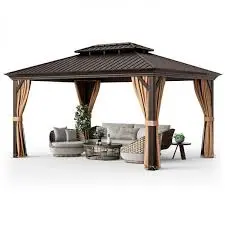

Across Canadian residential properties, outdoor living spaces are often underutilized due to sun exposure, rain, and insects. Fabric canopies provide temporary relief but degrade after a few seasons. A hardtop curved steel roof patio gazebo offers permanent, durable shelter for patios and decks. Canadian homeowners use these structures to create comfortable outdoor dining areas, lounge spaces, and gathering spots that remain usable across multiple seasons.
A homeowner in Ontario installed a hardtop gazebo over a south-facing deck. Before installation, the deck was unusable during summer afternoons due to intense sun. After installation, the family used the deck for 80 percent of summer meals. The steel roof blocked ultraviolet radiation while allowing cooling airflow. The mosquito nets allowed evening use without insect bites. The homeowner reported that the gazebo increased the usable square footage of the home by creating an outdoor room that served as a dining area, reading nook, and social space.
Design Principles and Structural Features
The gazebo features a curved steel hardtop roof. Unlike flat roofs that can pond water, the curved profile sheds rain and promotes snow runoff. The steel construction provides durability that fabric canopies cannot match. While fabric covers may need replacement every two to three years, the steel roof lasts for decades with minimal maintenance.
The frame combines powder-coated steel and aluminum. The four upright posts measure 4 inches by 4 inches, providing stable support for the roof structure. The crossbeams and top beams distribute the roof load evenly to the posts. The galvanized roof metal sheet is 26 gauge, thick enough to resist denting from hail while remaining light enough for assembly.
Key structural features include:
- Curved steel hardtop roof for water shedding
- Powder-coated steel and aluminum frame
- 4 by 4 inch upright posts for stability
- Galvanized 26 gauge roof sheet
- Pre-drilled anchor holes for secure mounting
The engineering behind the curved roof is noteworthy. The curvature increases the structural rigidity of the steel sheet, allowing a thinner gauge material to support greater loads. The shape also directs water toward the edges rather than allowing it to pool in the center. This design consideration is particularly valuable in regions with heavy rainfall or spring snowmelt.
Weather Protection and Durability
Canadian weather presents challenges for outdoor structures. Summer brings intense ultraviolet radiation that fades furniture and damages wood finishes. The steel roof blocks ultraviolet rays completely, unlike fabric canopies that allow some transmission. The brown marble powder coating resists fading, maintaining appearance for years.
Winter brings snow accumulation. The curved roof design prevents snow from building up in pockets that could cause collapse. Snow slides off the smooth steel surface, reducing the need for manual removal. The galvanized coating prevents rust from snowmelt and rain exposure. Unlike wood structures that can rot or warp, the steel and aluminum frame maintains its shape through freeze-thaw cycles.
Rain protection is another advantage. The hardtop roof is waterproof, unlike fabric that can leak at seams over time. The roof overhang keeps rain away from the seating area, allowing outdoor dining to continue during light showers. The 100 square foot covered area provides protection for a standard patio dining set seating six to eight people.
Performance factors that affect longevity include the quality of the powder coating, the thickness of the galvanized layer on the steel, and the grade of the aluminum used in the frame. Higher quality coatings resist chalking and fading longer, maintaining the appearance of the gazebo for years without repainting.
Insect Protection and Privacy Features
The double track system holds both mosquito nets and privacy curtains. The nets block mosquitoes, black flies, and other insects that can make evening outdoor time unpleasant. The mesh is fine enough to exclude even small insects while allowing airflow and visibility.
The privacy curtains are made of 180 gram polyester fabric. They can be drawn closed to block wind, create shade, or provide privacy from neighbors. When not needed, they slide open and secure with ties. This dual-layer system allows the user to adjust the level of enclosure from fully open to completely closed.
An Ontario homeowner reported that the mosquito nets allowed evening deck use for the first time in years. Previously, the family retreated indoors at dusk due to insect activity. With the nets closed, they enjoyed outdoor dinners throughout the summer without insect repellent. The curtains also provided protection from afternoon sun when the roof alone was insufficient.
The double track system is a key design feature. Separate tracks for nets and curtains mean that both can be used simultaneously without interference. The nets can remain in place while the curtains are drawn, or the curtains can be opened while the nets stay closed for insect protection with an open view.
Foundation and Installation Requirements
Proper installation is critical for safety and longevity. The gazebo must be anchored to a stable foundation. The included anchoring hardware allows installation on concrete pads, wood decks, or compacted ground. For grass or soil installation, ground stakes are provided.
The foundation must be level to prevent frame twisting. On concrete pads, expansion bolts secure the base plates. On wood decks, lag bolts attach through the pre-drilled holes. The 100 square foot footprint fits most standard patios and decks.
For properties without an existing patio, a concrete pad can be poured specifically for the gazebo. A pad thickness of 4 inches is typically sufficient. The pad should extend at least 6 inches beyond the gazebo footprint on all sides to provide stability and prevent soil erosion from undermining the foundation.
Safety Practices and Maintenance Guidelines
Safe gazebo use requires several key practices. The anchoring system must be inspected annually for tightness. Snow accumulation should be monitored and removed if it exceeds design limits. The mosquito nets should be inspected for tears that could allow insect entry. The curtains should be closed during high wind warnings to prevent flapping that could damage the fabric or the track system.
Key safety practices include:
- Anchor securely to concrete pad or deck
- Remove snow accumulation during heavy storms
- Inspect nets for tears before summer season
- Close curtains during high wind warnings
- Check anchor bolts for tightness annually
Maintenance is minimal compared to wood structures. The powder-coated frame requires occasional washing with mild soap and water. The steel roof should be inspected for scratches that could expose bare metal; touch-up paint should be applied to prevent rust. The curtains and nets can be removed and washed as needed.
Advantages
- Permanent steel roof lasts for decades
- Curved design sheds snow and rain
- Mosquito nets block insect entry
- Privacy curtains for wind and sun control
- Powder-coated frame resists corrosion
- 100 square feet of covered space
- Year-round durability
- No rotting, warping, or insect damage
- Minimal seasonal maintenance required
Limitations
- Requires concrete pad or wood deck
- Heavier than fabric canopies
- Not portable after installation
- Professional assembly recommended
- Higher cost than fabric alternatives
- Steel roof can be noisy during heavy rain
- Not insulated for winter heating
Industry Outlook
Hardtop gazebos represent a growing segment of the outdoor living market. As homeowners invest more in patios and decks, demand for permanent, durable shelter will likely increase. Future designs may include integrated ceiling fans for air circulation, solar-powered lighting for evening use, and retractable side panels for complete enclosure. Some manufacturers are exploring insulated roof panels for extended seasonal use and integrated gutter systems for rainwater collection. The combination of steel roof durability and insect protection makes these gazebos suitable for diverse Canadian residential applications.