
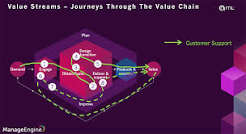
Most IT organizations need to deliver products and services faster while also ensuring that quality is maintained and costs are regulated to meet changing customer needs. However, to do so, teams cannot only manage individuals’ processes; instead, they must understand how workflows function across different departments, teams, and systems so that meaningful outcomes can be achieved. This is what makes value stream management important.
ITIL 5 aims to give teams the guidance they need in the form of identifying, verifying, and analyzing processes so that organizations can continually improve their value stream. This helps them understand work different tasks coming together to provide a shared value and not as the individual activities themselves.
What Is a Value Stream in ITIL 5?
A value stream is the ordered set of activities that are undertaken by an organization to create and deliver value to a customer. They are not like processes, which usually lay out the structure of how work is actually supposed to be done. Instead, value streams describe how work happens in real environments. There are typically two types of value streams:
Operational Value Stream
This value stream maps out the daily steps in the making of a product or service to give directly to an external customer. For example, fulfilling an e-commerce order.
Development Value Stream
A development value is the order of steps needed to develop, modify, or improve internal systems, software, and processes for smooth operational functionality for a company.
Looking through a value stream from the start to the finish helps organizations identify any possible delays or dependencies that may not have been detected easily if each department in an organization only focused on their own responsibilities.
ITIL 5 helps make workflows across departments easier to understand. For professionals looking to learn more about how this framework can enable organizational teams to do better, they can consider joining the ITIL 5 Foundation Certification course to learn how to enhance value streams.
How Does ITIL 5 Help Manage Value Streams?
Identify the Value Stream
To start value stream management effectively, it is important to know what value stream an organization wants to focus on. A good way to begin this is by determining what type of outcome a customer expects from a product or service.
ITIL 5 helps organizational teams to look at workflows across multiple departments. Value streams may involve multiple teams, suppliers, technologies, practices, and external organizations.
Maps the Current State
Once the desired value stream is chosen and identified, organizations can create a value stream to showcase the current state of their workflow. This unmodified map should detail all aspects of the workflow. This includes the activities, handoffs, dependencies, waiting periods, and other relevant pieces of information. Such documentation allows the invisible parts of the workflow to become visible.
For example, an organization’s current value stream can highlight issues like delayed service requests. The process, which should only take 30 minutes to resolve, ends up taking three days since most of its time is spent on waiting for approvals.
Analyses Bottlenecks and Waste
In ITIL 5, value streams are not just about mapping processes; it also encourages companies to look for scope for improvement. Some opportunities include:
- Removing excess approvals
- Avoiding repeated data entries
- Resolving unclear ownership
- Addressing long waiting periods
- Omitting unnecessary handoffs
- Automating manual activities
- Improving communication between teams
- Reducing dependencies on external suppliers
The aim of removing delays and waste is not to just improve individual teams and processes but to improve the overall flow of value from the beginning to the end.
Design the Future State
After understanding the current state of workflow and identifying potential hindrances within it, organizations can create their desired value stream, which maps out how they would like their workflow to look after incorporating improvements.
For example, an organization can introduce automated notifications and cut down on a seven-step approval process to three steps only. These improvements will be reflected in the value stream that an organization desires to achieve.
Implement and Measure Improvements
Once a value stream is redesigned, organizations should implement its desired improvements and measure whether those changes bring about better and favorable outcomes. Some yardsticks to measure by include waiting time, quality, customer satisfaction, cost, and other indicators that are relevant to the value stream.
Such measurements let teams understand whether their improvements work or if the organizations need to approach their workflow differently.
Value Stream Management Is Continuous
Managing a value stream is not and should not be treated like a one-time mapping exercise by organizations. Value streams will evolve continuously since factors like technologies, customer needs, and business priorities keep changing. This is why ITIL 5 encourages teams to relook and continuously improve value streams. This creates a continuous cycle from Identifying, Mapping, Analyzing, Improving, Measuring, and Reassessing.
Can Value Streams Work with Other Agile Practices?
Value stream management can also support other management frameworks like Agile. For example, professionals working with Agile product ownership can gain an understanding of how product prioritization connects with large organizational value.
Signing up for the SAFe POPM Certification Training can help professionals complement their ITIL knowledge with product management and product ownership skills within the Scaled Agile environments.
These methods can help organizations connect customer needs to product priorities, which leads to better service outcomes.
Conclusion
Value stream management with the ITIL 5 Foundation gives organizations a practical understanding of how work transitions from being a demand or requirement in the backlog to a product or service of tangible value. Organizations can learn how to make service management more effective by identifying value streams, mapping their current state, evaluating bottlenecks, implementing and measuring improvements, and regularly adapting their services and products as per business and customer requirements.
The most significant part of value stream management is the start-to-end view that it has about a product or service. ITIL 5 encourages organizations to improve every aspect of the development journey and view activities not as individual entities but as parts of a greater workflow aiming to deliver significant value to customers and stakeholders.