
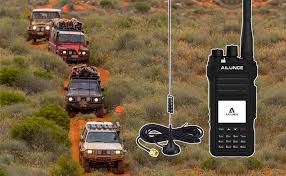

The map said there was a highway ahead.
The highway disagreed.
Somewhere deep between mountain roads, fading daylight, and a GPS that had clearly given up emotionally about twenty miles earlier, three vehicles sat pulled over near a trailhead debating whether they were still technically on the correct route.
Cell service? Gone.
Navigation apps? Frozen.
One person had climbed onto a rock holding their phone overhead like they were auditioning for a very low-budget survival documentary.
And yet, through all the confusion, the group stayed connected because of one thing quietly working in the background: walkie talkies.
Simple. Immediate. Reliable.
Funny how old-school technology suddenly feels very modern the moment everything else stops cooperating.
The Problem With Modern Communication
Most people don’t realize how fragile modern communication systems actually are until they leave cities behind.
Phones work brilliantly right up until they don’t.
A crowded concert overwhelms nearby towers. Mountain terrain blocks signal completely. Rural highways become dead zones stretching for miles. National parks often offer incredible scenery alongside communication coverage from approximately 2007.
And when connection disappears, coordination becomes stressful surprisingly fast.
Road trip groups get separated. Campers lose contact. Drivers miss turns. Families scatter across crowded attractions trying unsuccessfully to reconnect through delayed text messages that may or may not send eventually.
That’s exactly why walkie talkies continue thriving despite smartphones becoming central to modern life. Reliable direct communication still matters, especially in places where phones become unreliable little rectangles full of false confidence.
Mountains Have Never Respected Cell Towers
There’s something humbling about realizing a mountain does not care who your wireless provider is.
Outdoor travelers learn this quickly.
Hiking trails disappear into dense forests. Elevation changes block reception. Weather conditions interfere with signal strength. Remote campsites often exist in communication black holes where smartphones become useful mainly for taking photos and draining battery life.
Modern walkie talkies solve that problem by offering communication methods that don’t rely entirely on traditional cellular infrastructure.
Many long-range systems now support advanced push-to-talk communication and broader network connectivity capable of maintaining contact far beyond the limitations of older radios. That means hikers can stay connected across trails, camping groups can coordinate remotely, and outdoor travelers can communicate reliably even when phones stop functioning properly.
Which creates a very specific kind of peace of mind outdoors.
Especially after sunset.
Road Trips Get Chaotic Faster Than People Expect
Every multi-vehicle road trip eventually turns into a communication experiment.
One driver exits too early. Another stops for gas without warning the group. GPS apps reroute vehicles in different directions because traffic suddenly changed. Somewhere in the confusion, someone always says, “Wait… where did everybody go?”
And of course, this usually happens right as cell service starts fading.
Modern walkie talkies make road trip coordination dramatically easier because communication stays immediate between vehicles. Need to stop ahead? Spot traffic problems? Change routes? Warn the group about road closures or weather conditions? One quick message handles it instantly.
No dropped calls. No delayed texts. No dangerous attempts to type while driving.
Just direct communication that works while moving.
Honestly, it’s surprising more travel groups don’t use them.
Emergencies Change Everything About Communication
Here’s the uncomfortable truth nobody likes thinking about: communication matters most when situations become unpredictable.
Storms knock out towers. Wildfires overwhelm networks. Power outages interrupt infrastructure. During emergencies, cellular systems often become overloaded exactly when everyone starts trying to use them simultaneously.
That’s when reliable backup communication becomes incredibly important.
Modern walkie talkies offer an alternative communication layer capable of functioning independently from many of the systems smartphones depend upon. Some systems now support nationwide connectivity, allowing users to maintain communication across massive distances while bypassing local signal congestion issues entirely.
Emergency preparedness groups, travelers, outdoor enthusiasts, and families increasingly rely on these systems because they understand one important reality:
Communication should not depend entirely on whether nearby towers are having a good day.
Battery Life Quietly Became a Huge Advantage
Modern phones are exhausting.
Not emotionally, although sometimes yes, but electrically.
Navigation apps, streaming music, social media, notifications, background updates, maps constantly searching for weak signals… smartphones burn through batteries aggressively during travel and outdoor activities. Add cold weather or weak reception into the mix and battery life collapses even faster.
Modern walkie talkies take a much simpler approach.
Because communication is their primary purpose, many systems offer significantly longer battery performance during active use. Outdoor groups, travelers, road crews, and emergency responders all benefit from communication devices designed to stay operational for extended periods without constant charging.
Which matters tremendously once outlets disappear for a while.
Because nobody enjoys watching their last 4% battery while still miles away from help.
Modern Walkie Talkies Quietly Evolved
A lot of people still imagine walkie talkies as bulky devices with terrible sound quality and static-filled conversations from childhood camping trips.
The technology moved far beyond that years ago.
Today’s walkie talkies often include digital audio clarity, GPS functionality, noise reduction, weather resistance, encrypted communication, and advanced long-range connectivity that dramatically outperform traditional radios. Some systems now support communication across cities or even nationwide distances while maintaining simple push-to-talk operation.
The devices evolved while keeping the thing people valued most from the beginning: reliability.
No endless apps. No complicated setup. No distractions.
Push button. Talk instantly.
That simplicity still works because humans still need fast, dependable communication in unpredictable places.
Travel Feels Different When Communication Is Reliable
There’s a subtle shift that happens when people stop worrying about losing contact.
Road trips become less stressful. Outdoor adventures feel safer. Families spread out more confidently during travel. Groups coordinate naturally instead of constantly checking phones or searching for signal.
Reliable communication creates freedom.
That’s why walkie talkies continue growing beyond construction sites and emergency crews into camping gear, overlanding setups, family travel kits, hiking packs, and long-distance driving routines. People are rediscovering that dependable communication matters far more than endless digital features when environments become unpredictable.
Especially far from cities.
Especially in mountains.
Especially on highways where the next signal bar might be fifty miles away.
Reliable Communication Never Really Goes Out of Style
Technology changes constantly. Communication needs don’t.
People still need ways to stay connected during travel, emergencies, outdoor adventures, and situations where smartphones suddenly stop acting so smart. Modern walkie talkies succeed because they prioritize reliability over distraction, direct communication over complexity, and functionality over hype.
And honestly, that feels surprisingly refreshing now.
Because somewhere between mountains, highways, dead zones, and overloaded networks, people are remembering something important:
The best communication tool isn’t always the most advanced-looking one.
It’s the one that still works when everything else doesn’t.