
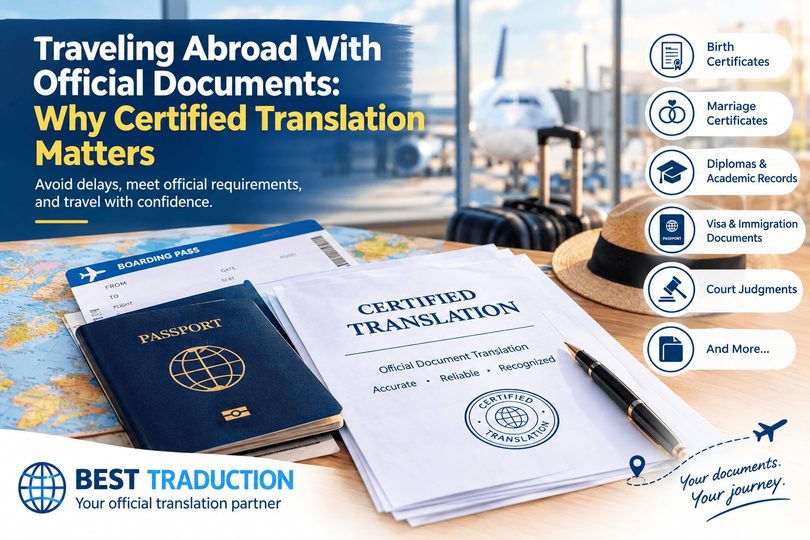

International travel often involves more paperwork than travelers initially expect. A passport and airline ticket may be enough for a short vacation, but longer stays, immigration procedures, study programs, family reunification, marriage abroad, or residence applications can require several official documents.
When these documents are written in a language that is not accepted by the destination country’s authorities, a translation may be required. In some cases, an ordinary translation is not enough. The authority may specifically request a certified or sworn translation prepared by a qualified translator.
Understanding this requirement before traveling can help avoid delays and unnecessary complications.
Why Official Documents May Need Translation
Governments and public institutions need to verify information contained in foreign documents. Birth certificates, marriage certificates, criminal record certificates, diplomas, court decisions, and other official records may contain information that must be understood by the authority processing an application.
For example, a traveler applying for a residence permit may be asked to provide a birth certificate or marriage certificate. A student may need to submit translated academic documents. Someone applying for nationality or family reunification may also be required to provide official civil-status records.
The translation requirements depend on the destination country, the type of procedure, and the institution receiving the documents.
In France, for example, official guidance explains that certain foreign-language documents may need to be translated by an approved translator, while some multilingual public documents can be exempt from translation depending on the applicable rules.
Certified Translation Is Different From Ordinary Translation
One of the most important distinctions travelers should understand is the difference between an ordinary translation and a certified or sworn translation.
An ordinary translation can be useful for understanding the contents of a document. However, an immigration office, court, university, embassy, or government administration may require a translation produced by a translator with a recognized official status.
The terminology also differs between countries. Terms such as certified translation, sworn translation, official translation, and authorized translation may have different meanings depending on the legal system.
For this reason, travelers should not assume that any professional translator will automatically satisfy the requirements of a particular authority.
Which Travel Documents May Need Translation?
The documents that require translation vary from one procedure to another. Common examples include:
- Birth certificates
- Marriage certificates
- Divorce certificates and judgments
- Criminal record certificates
- Diplomas and academic transcripts
- Court decisions
- Driving licences
- Employment certificates
- Proof of civil status
- Residence documents
- Business and corporate documents
- Immigration-related documents
A traveler should first identify exactly what the receiving authority requires before ordering a translation.
This is particularly important for visa and immigration applications, where submitting the wrong type of document or translation can result in additional requests and processing delays.
Translation for Visa Applications
Visa applications can involve numerous supporting documents. Depending on the destination and the purpose of travel, applicants may be asked for proof of employment, financial documents, civil-status records, invitation letters, accommodation documents, or educational records.
If one or more documents are written in another language, the visa authority may require translations.
However, the requirements are not universal. One embassy may accept a standard translation, while another may require certification or a translator recognized under its national rules.
Travelers should therefore consult the official website of the embassy, consulate, immigration authority, or visa center handling their application.
This simple step can prevent a traveler from paying for a translation that does not meet the authority’s specific requirements.
Immigration and Family Reunification
Translation becomes even more important when travel is connected to immigration or family reunification.
A person moving to another country may need to establish their identity, family relationship, marital status, education, or previous legal history. Official documents are often used to establish these facts.
For example, a family reunification application could involve birth certificates and marriage certificates issued in different countries and languages. Authorities need to be able to compare the translated information with the original documents.
A professional translator must therefore reproduce important details accurately, including names, dates, places, identification information, official terminology, stamps, and other relevant elements.
Do You Need an Apostille as Well?
Travelers sometimes confuse translation with authentication.
They are not necessarily the same thing.
An apostille or legalization may be required to authenticate certain public documents for use in another country. A certified translation, meanwhile, addresses the language of the document.
Depending on the procedure, an authority may require:
- The original document;
- An apostille or legalization;
- A certified translation;
- Or a combination of these requirements.
The applicable rules depend on the countries involved and the type of document.
Therefore, travelers should verify whether authentication is required before sending their documents to a translator.
How to Prepare Documents Before Traveling
A little preparation can make an international journey considerably easier.
Before traveling, consider the following steps:
1. Check the official requirements
Visit the website of the relevant embassy, consulate, immigration authority, university, or government department.
2. Identify which documents require translation
Do not translate every document unnecessarily. Focus on the documents specifically requested by the authority.
3. Check whether certification is required
Find out whether an ordinary translation is sufficient or whether the authority requires a certified, sworn, or authorized translation.
4. Check whether an apostille is necessary
Authentication requirements should be checked separately from translation requirements.
5. Allow enough processing time
Certified translations may require additional preparation, formatting, certification, or delivery time. Travelers should avoid waiting until immediately before departure.
Choosing a Professional Translation Service
When an official translation is required, travelers should verify the translator’s qualifications and whether the translator’s status is recognized for the intended procedure.
It is also useful to provide the translator with the exact instructions received from the embassy, immigration authority, university, or other institution. This allows the translator to understand the purpose of the translation and the applicable requirements.
BEST TRADUCTION provides professional translation services for official documents, including civil-status, academic, administrative, and legal documents intended for international procedures.
Travelers can review the available services and submit their documents through BEST TRADUCTION before beginning their administrative process.
Why Preparation Matters for International Travelers
Travel preparation is not limited to booking flights and accommodation. For travelers dealing with visas, immigration, education, employment, marriage, or long-term residence, official documentation can be an essential part of the journey.
A missing translation or an incorrectly prepared document may lead to additional administrative requests and potentially delay an application.
The safest approach is to check the requirements directly with the authority responsible for the procedure. Travel-warning and travel-news websites can provide useful general information, but travelers should rely on official government or diplomatic sources for the final requirements applicable to their individual case. Travel Warning News itself advises readers to verify important travel information with official sources because conditions and requirements can change.
Conclusion
Certified translation can play an important role when official documents cross international borders. Whether the purpose is a visa application, immigration procedure, education, family reunification, or another administrative process, the correct translation can help ensure that documents are presented in a form the receiving authority can process.
The key is to determine the requirements before traveling. Check whether a translation is required, whether it must be certified or sworn, and whether the original document also needs an apostille or legalization.
For international travelers, preparing these documents in advance can make the administrative side of an international journey much more straightforward