
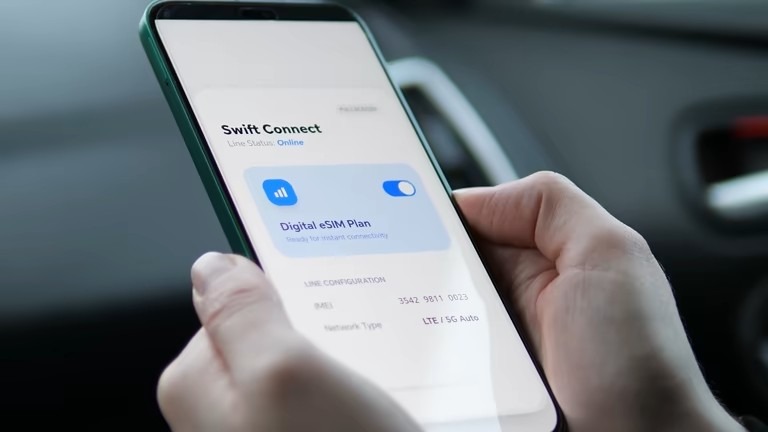
Europe in 2026 is a continent of seamless border crossings, high-speed rail connections, and instantly shareable moments yet for millions of travelers each year, the question of mobile connectivity remains a source of unnecessary stress and expense. The rise of eSIM technology has changed that equation permanently. This guide covers everything a modern European traveler needs to know: what an eSIM is, why it matters, which providers lead the market, and how to get the most out of your data plan from the moment you land.
What Exactly Is an eSIM and How Does It Work?
An eSIM short for embedded SIM is a programmable SIM card soldered directly into your device’s motherboard. Unlike a physical SIM that you slot in and out, an eSIM stores multiple carrier profiles digitally and switches between them on command. You purchase a plan, receive a QR code by email, scan it, and your phone registers on a new network typically in under two minutes.
For European travel, this is a revelation. The continent spans over 40 nations, each historically operating its own network infrastructure. An eSIM regional plan collapses that complexity into a single purchase, a single profile, and automatic network selection as you move from one country to the next.
Compatibility has expanded dramatically. As of 2026, virtually every flagship smartphone released since 2022 including iPhone XS and later, Samsung Galaxy S21 and beyond, Google Pixel 4 onwards, and most premium Android devices supports eSIM. If your phone is carrier-unlocked, you are ready to go.
The Real Cost of Staying Connected in Europe Without an eSIM
The financial case for an eSIM over traditional roaming is overwhelming. Most home carriers charge a daily roaming add-on of $10 to $15 per day for European coverage. A two-week trip translates to $140–$210 in connectivity costs alone and that figure assumes you are disciplined enough to turn off roaming the moment you land, which many travelers forget to do. A single evening of absent-minded streaming can add $50 or more to a phone bill.
The alternative of buying a local SIM card on arrival sounds appealing in theory but crumbles in practice for multi-country itineraries. You face language barriers, mandatory ID registration in several EU member states, and the irritating ritual of swapping a tiny physical card at every border. For a thorough breakdown of leading eSIM providers and their current pricing, the eSIM Europe guide from Travel Daily News offers a valuable reference point with current market analysis.
A quality eSIM regional plan for Europe in 2026 covers the same two-week trip for $13 to $40, depending on data volume and provider. The savings are not marginal they are transformative, especially for budget and backpacker travelers.
The Leading eSIM Providers for Europe in 2026
The European eSIM market has matured into a competitive ecosystem with clear category leaders. The six providers below consistently receive the highest ratings across independent travel publications and real-world user testing:
Airalo — The original eSIM marketplace and still the most trusted name in the space. Airalo’s Europe regional plan spans 42 countries the widest continental footprint of any provider. Its app is widely regarded as the most intuitive for first-time eSIM users, and its customer service is reliably responsive. Plans start from approximately $5 for 1 GB, scaling to multi-GB options for longer journeys.
Ubigi — Consistently rated the top overall eSIM for Europe in 2026 by multiple independent tech reviewers. Ubigi is backed by the NTT Group and offers a range of flexible plan structures from a $2 / 500 MB two-day plan to monthly subscriptions from $8 per month for 5 GB, and annual plans from $24 for 24 GB. Its data tethering support makes it the preferred choice for travelers who need to share a connection with companions.
Saily — A premium-positioned provider that bundles connectivity with security. Every Saily plan includes a built-in ad blocker and a virtual location feature comparable to a basic VPN. Coverage spans 35 European countries with robust 5G connectivity. Entry pricing begins at $4.99 for 1 GB over 7 days, with long-stay 90-day options available for extended European adventures.
Holafly — The undisputed market leader for unlimited data plans. Holafly is the go-to choice for remote workers, streamers, and heavy users who cannot risk throttling or data caps. Pricing is higher than data-capped alternatives, but the consistency and peace of mind it delivers justify the premium for the right traveler profile.
Jetpac — The standout budget option of 2026, offering 10 GB of European coverage from just $13 one of the lowest cost-per-gigabyte ratios available. Jetpac also supports unlimited mobile hotspot sharing, making it the smartest choice for group travel. Its global footprint of 200+ destinations means it doubles as a worldwide travel companion beyond Europe.
Nomad — Known for accessible entry-level pricing and reliable coverage across 36 European countries. Nomad is particularly well-suited to travelers who need dependable connectivity in major cities and transport hubs without paying a premium. Speeds in some rural regions can be slower than primary network providers, but for typical urban itineraries, performance is consistent.
How to Select the Right eSIM Plan for Your European Itinerary
No single eSIM plan is universally optimal. The right choice depends on the specific shape of your trip. Before purchasing, evaluate each of the following criteria against your personal travel profile:
- Countries on your itinerary — Confirm that every destination is covered, especially non-EU member states including the United Kingdom, Switzerland, Norway, Turkey, and Balkan nations such as Albania and Kosovo, which are excluded from some regional plans.
- Data volume requirements — Research suggests the average leisure traveler consumes 1 to 2 GB of data per week. Remote workers, video callers, or frequent streamers may need 5 to 10 GB per week, making unlimited plans more cost-effective.
- Trip duration — Short trips of five to seven days are well served by day-based or weekly plans. Journeys of two to four weeks typically benefit from a 30-day plan, while multi-month travel should explore monthly subscription options.
- Voice and SMS needs — The majority of Europe eSIM plans are data-only. If you require an active European phone number for calls or text messages, verify explicitly that your chosen provider supports voice capability before purchase.
- Device compatibility and carrier lock status — Confirm your smartphone model supports eSIM and that it is not carrier-locked to your home network. Locked devices require unlocking before a third-party eSIM can be installed.
Coverage Reality: What to Expect Across Europe’s Regions
Marketing language around eSIM coverage can be misleading. A plan that claims pan-European coverage may still deliver inconsistent performance depending on how the provider partners with local networks. Understanding these nuances before you travel will set accurate expectations:
Western European capitals Paris, Berlin, Madrid, Rome, Amsterdam, and Lisbon all deliver reliable 4G and 5G connectivity with any of the top-tier providers. Urban coverage is effectively universal.
Alpine and mountainous regions — Coverage in the Swiss Alps, the Dolomites, and the Pyrenees can be inconsistent, particularly on high-altitude trails and remote valley roads. Providers that partner with primary local networks perform better here than those using secondary MVNO agreements.
Eastern Europe — Poland, Czech Republic, Hungary, Romania, and the Baltic states are well covered by most regional plans. However, the Western Balkans — Serbia, Bosnia, Albania, Kosovo, and North Macedonia — are excluded from several providers’ maps and require careful verification.
Rural Scandinavia and Ireland — Remote areas of Norway, Sweden, Finland, and rural Ireland can have limited coverage. Download offline maps before venturing into isolated regions.
Underground transit — Metro connectivity varies dramatically by city. Prague, Stockholm, and Helsinki have excellent underground cellular access; London’s Underground and Paris’s Métro have partial but improving coverage as infrastructure upgrades continue through 2026.
Step-by-Step: Installing and Activating Your Europe eSIM
The installation process for a European eSIM is straightforward, but a few critical steps can prevent common frustrations:
- Purchase your eSIM plan at least 48 hours before departure. This allows time to resolve any account or compatibility issues while you still have access to reliable home Wi-Fi.
- Install the eSIM profile at home, not at the airport. Download the carrier profile via the QR code while connected to stable, fast Wi-Fi. Airport networks are frequently congested and unreliable for eSIM provisioning.
- Do not activate the plan until you arrive in Europe. Most eSIM plans begin counting your data validity period from the moment of activation, not installation. Install the profile in advance, but defer activation until you land.
- Screenshot the QR code and store it in a cloud folder. Many eSIM profiles can only be installed once. If your phone is lost, reset, or replaced, access to the original QR code may be essential for reinstallation.
- Disable data roaming on your primary SIM after activating the eSIM. This prevents accidental charges from your home carrier’s roaming rates while the eSIM handles all data connectivity.
- Monitor your data balance through the provider’s app. Most leading providers — Airalo, Ubigi, Saily, and Jetpac — offer real-time usage tracking within their platforms.
eSIM Europe vs. Roaming vs. Local SIM: A Decisive Comparison
The three connectivity options available to European travelers each carry distinct trade-offs. For a multi-country, two-week trip, the comparison is particularly stark:
Home carrier roaming: Convenient but deeply expensive at $140–$210 for two weeks. Best reserved for emergency short-term use when no alternative is available.
Local SIM card: Potentially the cheapest per-gigabyte option within a single country, but impractical across borders. Requires in-person purchase, ID verification in countries such as France, Spain, and Germany, and a physical SIM slot.
Europe eSIM: The clear optimal choice for multi-country itineraries. Cost of $13–$40 for 10–20 GB over 30 days. Instant activation before travel, no physical card, dual-SIM capability preserved, and seamless automatic network switching at borders. The decisive choice for 2026 European travel.
How Much Data Do You Actually Need for Europe?
One of the most common mistakes travelers make when purchasing a European eSIM is either over-buying data they do not use or under-buying and running out at an inconvenient moment. Understanding your personal data consumption pattern is the foundation of a well-calibrated plan.
- Light users (messaging, maps, occasional social media) — 500 MB to 1 GB per week is typically sufficient. A 3 GB plan covers most two-week trips comfortably.
- Moderate users (daily social posting, video calls, navigation, news) — Plan for 1.5 to 3 GB per week. A 10 GB regional plan is the sweet spot for a two-week journey.
- Heavy users (remote work, frequent video streaming, hotspot sharing) — Data consumption can reach 5 to 10+ GB per week. Unlimited plans from providers like Holafly are worth the premium to eliminate anxiety.
- Group travelers — If you plan to share your eSIM connection via mobile hotspot, multiply individual estimates accordingly and prioritize providers like Ubigi and Jetpac that explicitly support tethering.
Smart Strategies to Maximize Your eSIM Data in Europe
Even the most well-chosen eSIM plan benefits from a few practical data conservation habits:
- Pre-download offline maps before leaving accommodation each morning. Google Maps and Maps.me both support robust offline navigation that eliminates the single largest drain on travel data.
- Use hotel, hostel, and café Wi-Fi for heavy tasks — streaming, uploading photos, video calls, and app updates. Reserve your eSIM data for on-the-move connectivity.
- Enable data saver mode in your smartphone’s system settings. Most modern Android and iOS devices offer built-in data management tools that restrict background app activity significantly.
- Search for promotional codes before purchasing. Providers including Ubigi regularly offer 10% off first purchases, and seasonal travel promotions are common around peak European travel periods.
- Consider topping up proactively rather than reactively. Most providers charge a premium for emergency top-ups. Buying a slightly larger plan upfront almost always works out cheaper than mid-trip additions.
The Future of eSIM Technology in European Travel
The eSIM landscape is still evolving rapidly, and 2026 represents an inflection point rather than an endpoint. Several developments are shaping the medium-term future of travel connectivity in Europe:
- 5G expansion — Major European cities are now well served by 5G networks, and leading providers have updated their eSIM profiles to access them. Rural 5G is expanding across Germany, France, and the Netherlands in particular, with broader rollout expected through 2027.
- iSIM technology — The next evolution beyond eSIM, iSIM integrates the SIM function directly into the device’s main processor chip. While not yet mainstream, flagship devices from late 2025 onwards are beginning to include iSIM support, further reducing hardware complexity.
- Plan flexibility — Providers are increasingly offering pay-as-you-go and day-pass eSIM structures, giving travelers greater granularity over their data spend without committing to fixed packages.
- Voice-capable eSIMs — The gap between data-only and voice-capable eSIM plans is closing. Several providers now offer European plans that include a local phone number, a feature previously limited to physical SIM cards.
Final Verdict: The Best eSIM for Europe in 2026
After evaluating coverage, pricing, flexibility, and real-world performance, the eSIM market in 2026 rewards travellers who match their provider to their specific needs rather than defaulting to the first result they encounter.
- Best overall value — Ubigi, with the most flexible plan structure, data tethering support, and prices from $2 for short stays.
- Widest European coverage — Airalo, spanning 42 countries with a trusted marketplace model and the most user-friendly installation process.
- Best for privacy and security — Saily, combining 5G connectivity with a built-in ad blocker and virtual location on every plan.
- Best for unlimited data — Holafly, the definitive choice for remote workers and heavy users who cannot risk running short.
- Best budget pick — Jetpac, delivering 10 GB for $13 with hotspot sharing, and bulk-purchase discounts for frequent travelers.
- Best for simplicity — Nomad, offering clean pricing and reliable urban coverage without unnecessary complexity.
The era of paying hundreds of dollars to stay connected on a European trip is over. An eSIM plan removes cost, friction, and uncertainty from the equation — leaving you free to focus on the extraordinary experience of traveling through one of the world’s most diverse and rewarding continents. Book smart, travel connected, and make every moment in Europe count.